
Key Takeaways
| Question | Short Answer |
|---|---|
| How much does radiant floor heating cost per square foot? | Our local pricing typically falls around $6–$15 per sq ft for radiant floor heating, depending on system type and project complexity. You can see a detailed Calgary breakdown in our guide on how expensive it is to put in heated floors. |
| Is retrofit radiant more expensive than new-construction? | Yes. Retrofit radiant floors usually cost 30–80% more than comparable new-construction systems because of demolition, floor build-up, and labour-intensive installation. |
| What costs more, electric or hydronic radiant? | Electric is often cheaper to install ($5–$10 per sq ft) but more expensive to operate, while hydronic systems typically run $10–$20 per sq ft installed but have lower long-term operating costs, especially in colder climates like Calgary. |
| What does a whole-house radiant system cost? | For a mid-size home, national data shows $20,000–$60,000 for hydronic radiant, which lines up with what we see on many Calgary projects that include boiler, manifolds, and controls. |
| Is radiant floor heating efficient enough to justify the cost? | Yes in many homes. Operating costs often fall between $65 and $250 per month, and radiant can reduce hot and cold spots, improve comfort, and help manage long winter heating bills when properly designed and installed. |
| Should I install radiant when building a new home? | If radiant comfort is on your wish list, new construction is the ideal time. Our new installation services are set up to design in-floor systems while the structure is still open, which keeps costs lower and design options higher. |
| Can I combine radiant floors with a boiler upgrade? | Absolutely. We often pair in-floor heating with new residential boiler systems to improve overall efficiency and reliability. |
1. Radiant Floor Heating Basics: What You Pay For
Radiant floor heating uses warm water or electric elements beneath the floor surface to heat rooms evenly from the ground up. From a cost perspective, every system includes three main components: the heat source, the distribution in the floor, and the control system.Hydronic vs Electric: Cost Drivers
Hydronic radiant uses a boiler and tubing to circulate hot water through the floors. Electric radiant uses cables or mats that heat up directly when powered.- Hydronic radiant floor heating: typically $10–$20 per sq ft
- Electric radiant floor heating: typically $5–$10 per sq ft
- Radiant floor heating retrofit: often $6–$15 per sq ft or more, depending on demolition and rebuild
2. New Construction Radiant Floor Heating Costs Explained
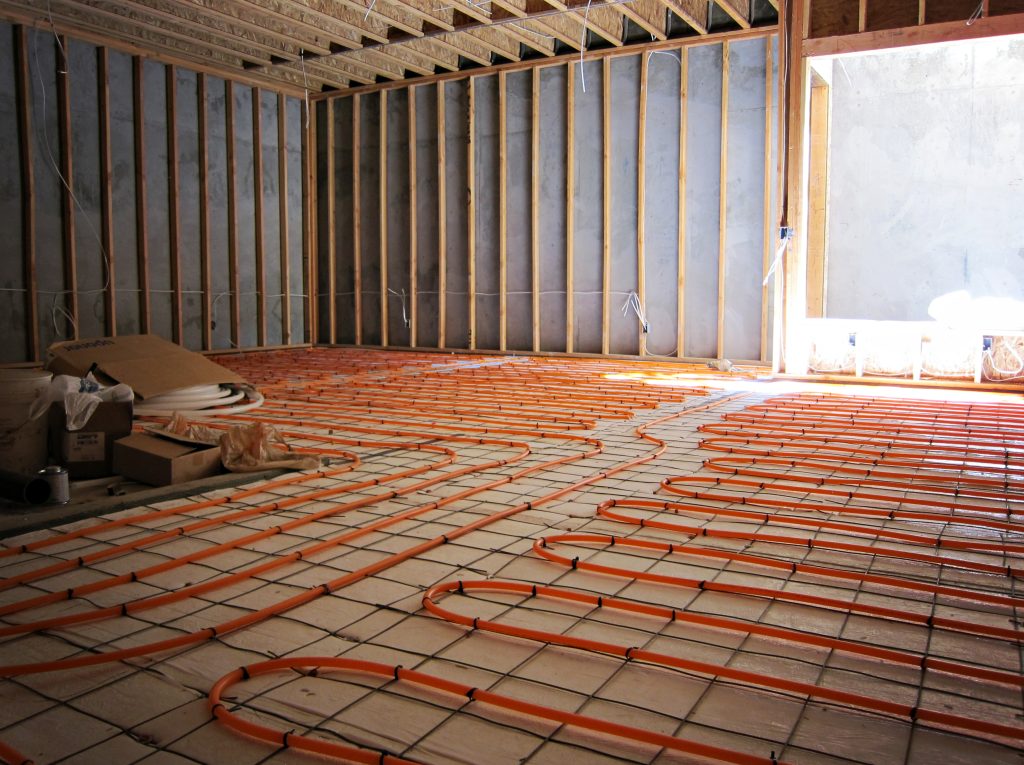
When we install radiant floors during new construction, we work in step with your builder while the structure is still open. This timing lets us embed tubing or electric mats before flooring goes in, which reduces labour and avoids costly demolition.Typical New Construction Price Ranges
Across industry data, new-construction radiant floor pricing usually falls around $6–$15 per sq ft, depending on system type and floor assembly. For hydronic radiant, area-based pricing often runs 55–75 per m² installed, which fits typical whole-home projects in new builds. Electric radiant mats in new builds usually cost less up front when used in smaller areas, although they can be less economical over large square footage.| System Type | New Build Typical Cost | Best Use Case |
|---|---|---|
| Hydronic radiant | $10–$20 per sq ft | Whole-home or main-level heating |
| Electric radiant | $5–$10 per sq ft | Bathrooms, entries, small zones |

3. Retrofit Radiant Floor Heating Costs: Why They Are Higher
Retrofit radiant means we install in-floor heating in an existing home, which usually involves working around finished spaces. This often requires removing flooring, preparing the subfloor, adjusting doors and transitions, and sometimes modifying structure or ceilings below to run piping or wiring.Retrofit vs New-Construction Price Comparison
Across published data, retrofit radiant floor installs typically cost 30–50% more than similar new-construction systems. In some cases, especially with complex demolition or structural changes, retrofit costs can be 50–80% higher than new builds. Hydronic radiant in new construction often falls around 55–75 per m², while retrofit over-pour installs are more likely in the 75–95 per m² range. For a mid-size home of around 2,000 sq ft, that premium can add many thousands of dollars to the total budget.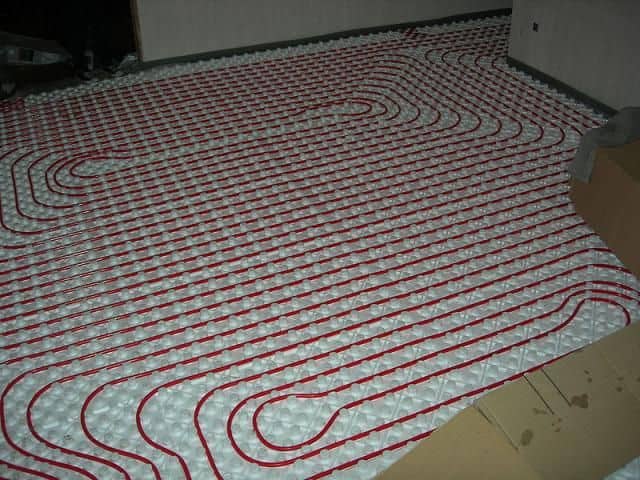
4. Cost Breakdown: Per Square Foot And By System Type
When we prepare budgets with clients, we often start with per-square-foot benchmarks. These figures help you compare options room by room and understand how system selection impacts total cost.Per-Square-Foot Benchmarks You Can Use
Across multiple industry sources, new-construction radiant floor pricing typically falls at about $6–$15 per sq ft for most residential projects. Retrofit pricing is usually closer to $8–$20 per sq ft, depending on how much demolition, subfloor work, and re-finishing is required. Whole-house hydronic radiant for a 2,000 sq ft home often totals $20,000–$60,000, while another dataset gives a typical range of $26,000–$54,000 for similar projects, including system and installation. A 2,300 sq ft radiant-floor project, such as a full-home renovation, can cost roughly $13,800–$48,000 when you include flooring removal and reinstallation.| Scenario | Typical Installed Cost |
|---|---|
| New-construction radiant floors | $6–$15 per sq ft |
| Retrofit radiant floors | $8–$20 per sq ft |
| Whole-house hydronic, 2,000 sq ft | $20,000–$60,000 total |
A quick visual comparison of radiant floor heating costs for retrofit vs. new construction. The infographic highlights five essential cost factors to guide budgeting.
5. Hydronic vs Electric Radiant: Price, Retrofit Fit, And Operating Costs
Choosing between hydronic and electric radiant is one of the biggest cost decisions you will make. We consider up-front cost, monthly operating cost, and whether your project is a small-area retrofit or a full-home system.Hydronic Radiant Heating Costs
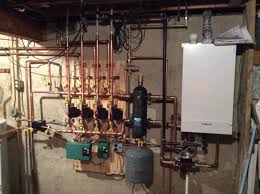
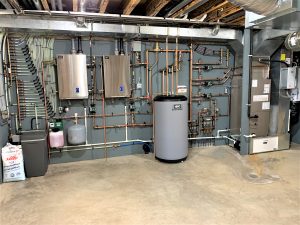
Hydronic systems use a boiler, manifolds, pumps, and tubing, so the initial hardware investment is higher. Installed hydronic radiant commonly falls between $10–$20 per sq ft, with some systems priced at $6–$20 per sq ft depending on design, insulation, and aluminium transfer plates. Hydronic retrofit pricing can reach around $18–$22 per sq ft, while comparable new hydronic installs might range closer to $15–$18 per sq ft.Electric Radiant Heating Costs
Electric radiant mats and cables are simpler, which keeps installation labour lower. Typical installed cost for electric radiant mats runs about $8–$15 per sq ft, which fits the $5–$10 per sq ft range we often use as a guideline for many Calgary projects. Electric radiant is especially attractive for targeted retrofit zones, with some sources showing 30–50 per m² for small areas like bathrooms and entries.Did You Know?
Typical installed cost per square foot by system type is about $8–$15 for electric mats, $6–$20 for standard hydronic radiant, and $10–$25 for hydronic with aluminum plates, so system design has a direct impact on your final budget.
6. Flooring Choices And Their Impact On Radiant Heating Costs
Flooring material has a direct impact on both radiant performance and installation cost. Some materials conduct heat very efficiently, while others require extra planning or are not ideal for certain systems.Best Flooring Options For Cost And Performance
Tile and stone are among the best partners for radiant floors because they conduct heat very efficiently. From a cost standpoint, they may not be the cheapest floor finishes, but they let the radiant system run at lower water temperatures, which can save energy over time. Wood, laminate, vinyl, and rubber can also work with radiant heating when properly selected and installed. We pay close attention to manufacturer temperature limits and expansion characteristics, especially on retrofit projects where we are tying into existing finishes.When we design a radiant system, we always match the heat output and water temperature to the flooring type so you get comfort without damaging the floor.
7. Labour, Demolition, And Hidden Retrofit Costs
Material pricing is only part of the story. Labour, demolition, and finishing work often separate a cost-effective new build from a more expensive retrofit.What Adds Cost To Retrofit Radiant Floors
On retrofit projects we commonly address:- Removal and disposal of existing flooring and possibly subfloor
- Levelling or reinforcing floors before new radiant assembly
- Raising floor height and adjusting doors, trim, and transitions
- Working from below, which can affect finished ceilings
8. Operating Costs: Monthly Bills For Radiant Floors
Up-front cost is only part of your investment. We always encourage homeowners to consider long-term operating costs when choosing between electric and hydronic radiant, or between retrofit and new builds.Monthly Operating Cost Benchmarks
Industry data shows that monthly operating costs for radiant floor heating generally fall between $65 and $250 per month. The wide range depends on system type, home insulation, local energy rates, and how you control the system. Hydronic systems paired with a high-efficiency boiler can provide very cost-effective heat for larger homes and long winters. Electric radiant is often best used as a comfort upgrade in specific rooms because electricity costs can add up when heating large areas.Did You Know?
Average radiant-floor cost to heat a whole 2,000 sq ft home is about $26,000–$54,000 installed, which many homeowners recover over time through increased comfort, efficiency, and a reported 3–5% premium in home resale value.
9. When Retrofit Radiant Heating Makes Financial Sense
Even with the higher cost, retrofit radiant floors can still be a smart investment in certain situations. We often recommend retrofit radiant when homeowners are already planning major renovations that involve floors, plumbing, or mechanical upgrades.Good Candidates For Retrofit Radiant
You may benefit from retrofit radiant if:- You are replacing flooring anyway as part of a renovation
- Your existing heating system is near end of life and due for replacement
- You have chronic cold spots or comfort issues that forced-air cannot solve
- You want to increase home value with a premium comfort feature